Political system
A parliamentary republic, 1931–1936
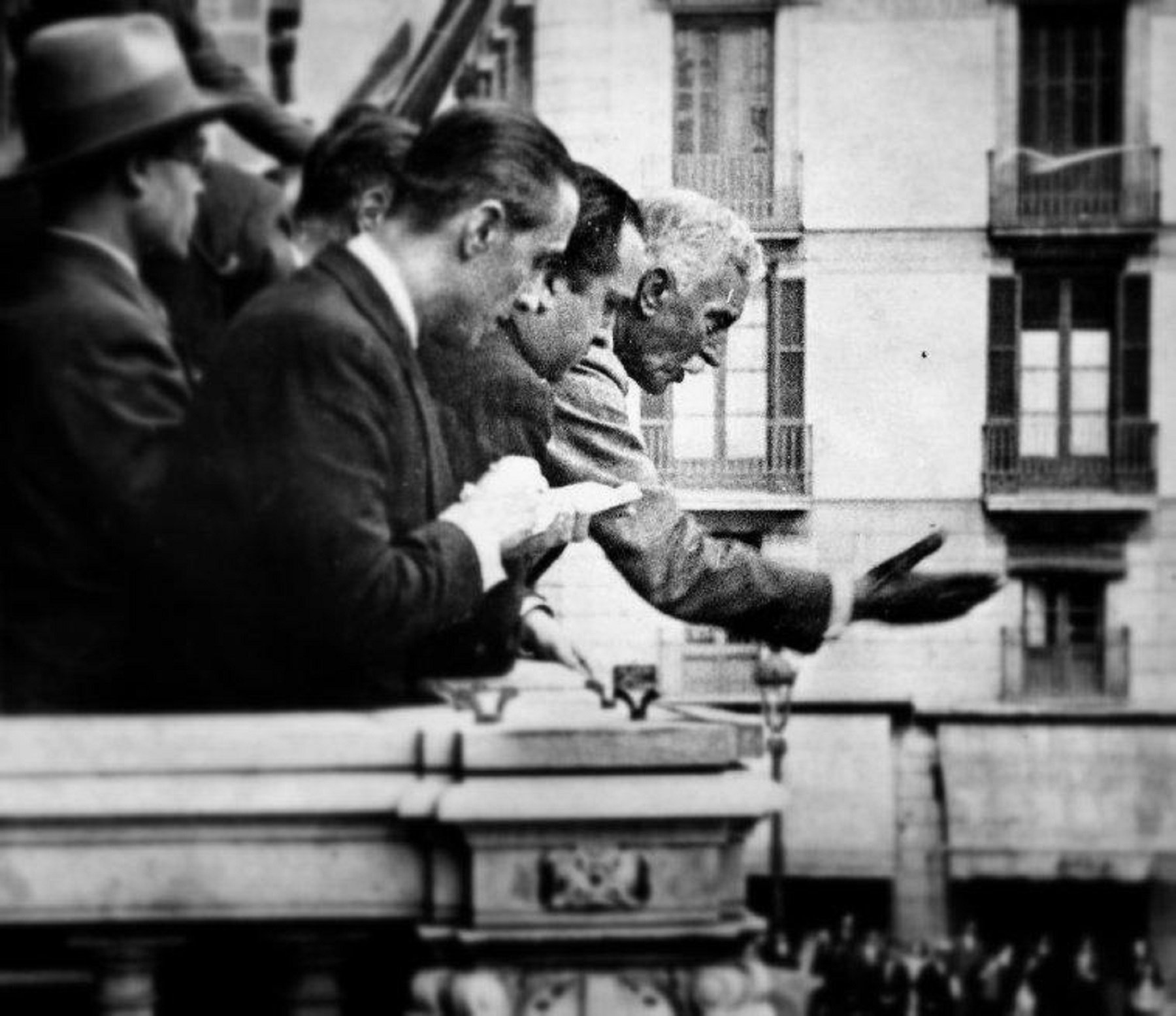
The Second Spanish Republic was proclaimed on 14 April 1931, following municipal elections held two days earlier in which republican candidates achieved an overwhelming victory in Spain's major cities, prompting King Alfonso XIII to hastily leave the country.
The Constitution of 9 December 1931 established Spain as a "democratic republic of workers of all classes" organised around four pillars.
A unicameral legislature. The Republic abolished the Senate that had existed under the Restoration monarchy. The Cortes became a single chamber of 473 seats, elected every four years by universal suffrage. All legislation required Cortes approval, and the chamber could also censure and remove governments.
A dual executive. The President of the Republic was head of state, elected for a six-year term by a joint assembly of sitting members of parliament and an equal number of electors chosen in a popular vote. The Prime Minister (Presidente del Consejo de Ministros) was head of government, appointed by the President and accountable to the Cortes. In practice, governments formed and fell according to parliamentary majorities.
A constrained dissolution power. The President had the power to dissolve the Cortes, but could only exercise it twice during a single presidential term. If the President dissolved the chamber a second time, the incoming Cortes had the right to examine the grounds for dissolution and, by absolute majority, remove the President from office if they deemed the dissolution improper. This provision was eventually triggered: Niceto Alcalá-Zamora (centre right Catholic republican) dissolved the Cortes early in January 1936 for the second time, following a first dissolution in 1933, and the newly elected Popular Front Cortes voted to depose him in April 1936.
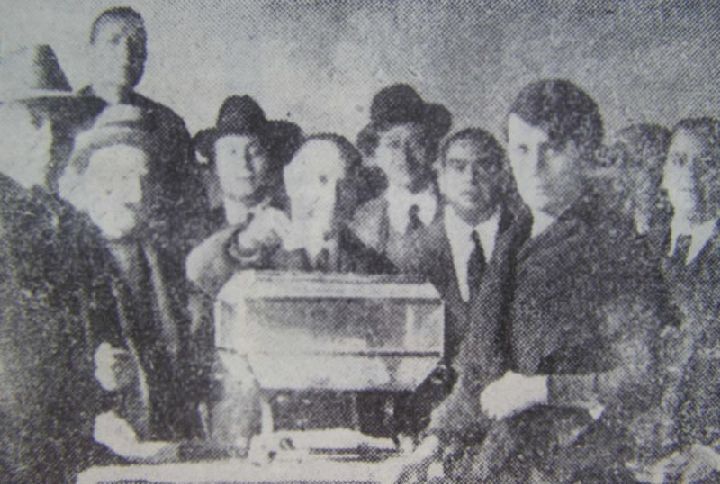
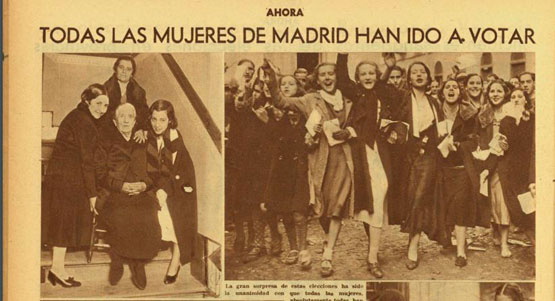
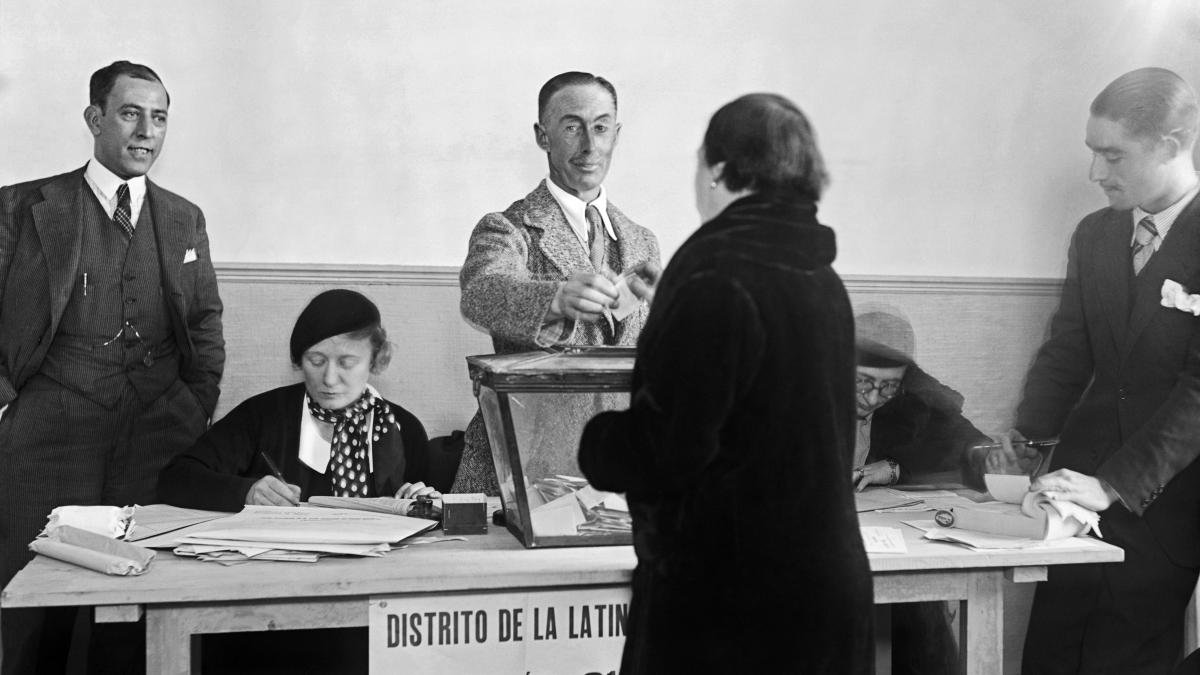
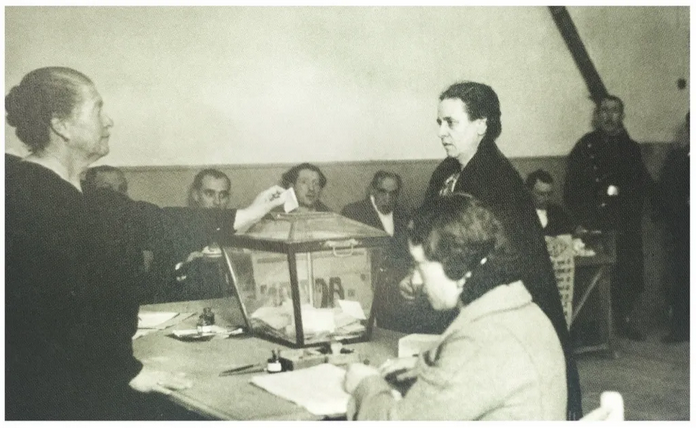
Universal suffrage, including women (from 1933). Article 36 of the 1931 Constitution granted full voting rights to all citizens aged 23 and over, regardless of sex. Spain became one of the first countries in continental Europe to introduce equal universal suffrage. Women voted for the first time in the November 1933 election.
Institutional evolution
From the Provisional Government to the Civil War
Apr–Dec 1931
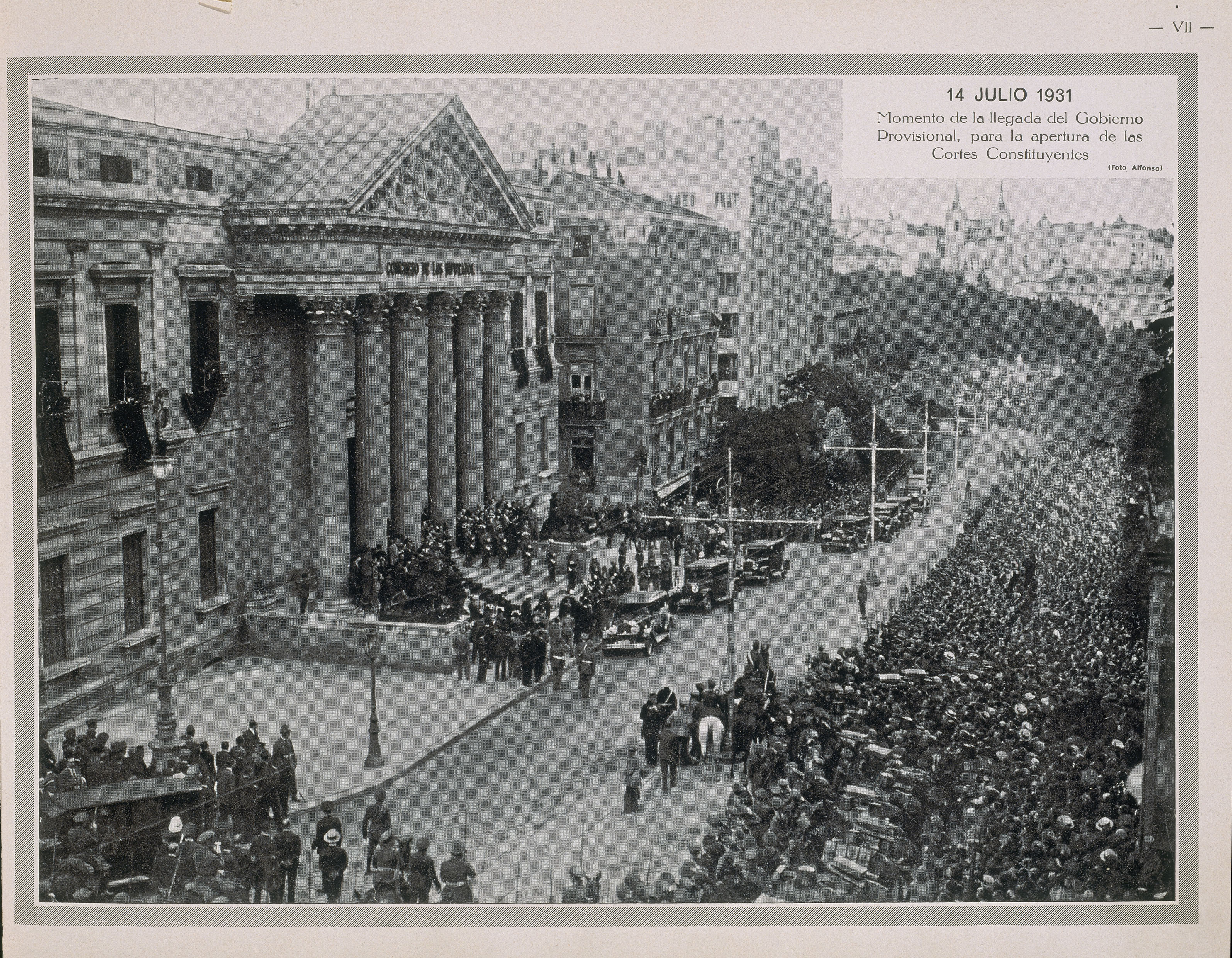
Provisional Government. Manuel Azaña (left republican) serves as Prime Minister under President Alcalá-Zamora (centre right Catholic republican). The new Constituent Cortes, elected in June 1931, drafts and approves the new constitution. The Statute of Autonomy of Catalonia is debated.
Dec 1931–Sep 1933
First legislature. The Azaña government pursues major reforms: land redistribution, separation of church and state, military reorganisation, and the approval of the Statute of Autonomy of Catalonia (September 1932). The coalition loses its majority in September 1933; Alcalá-Zamora dissolves the Cortes.
Nov 1933–Jan 1936
Second legislature (bienio negro / bienio rectificador). Alejandro Lerroux (centrist Radical Republican) leads successive governments with parliamentary support from the CEDA (Catholic conservative). The October 1934 Asturian miners' uprising and Catalan separatist declaration are suppressed. Recurring government crises lead Alcalá-Zamora to dissolve the Cortes a second time in January 1936.
Feb–Jul 1936
Third legislature. The Popular Front wins the February elections. Manuel Azaña (left liberal republican) is elected President of the Republic. Santiago Casares Quiroga (Izquierda Republicana, left liberal republican) heads the government. The military uprising of 17–18 July 1936 triggers the Civil War, ending the Republic's constitutional order.
Electoral system
A majority-biased system built for coalitions
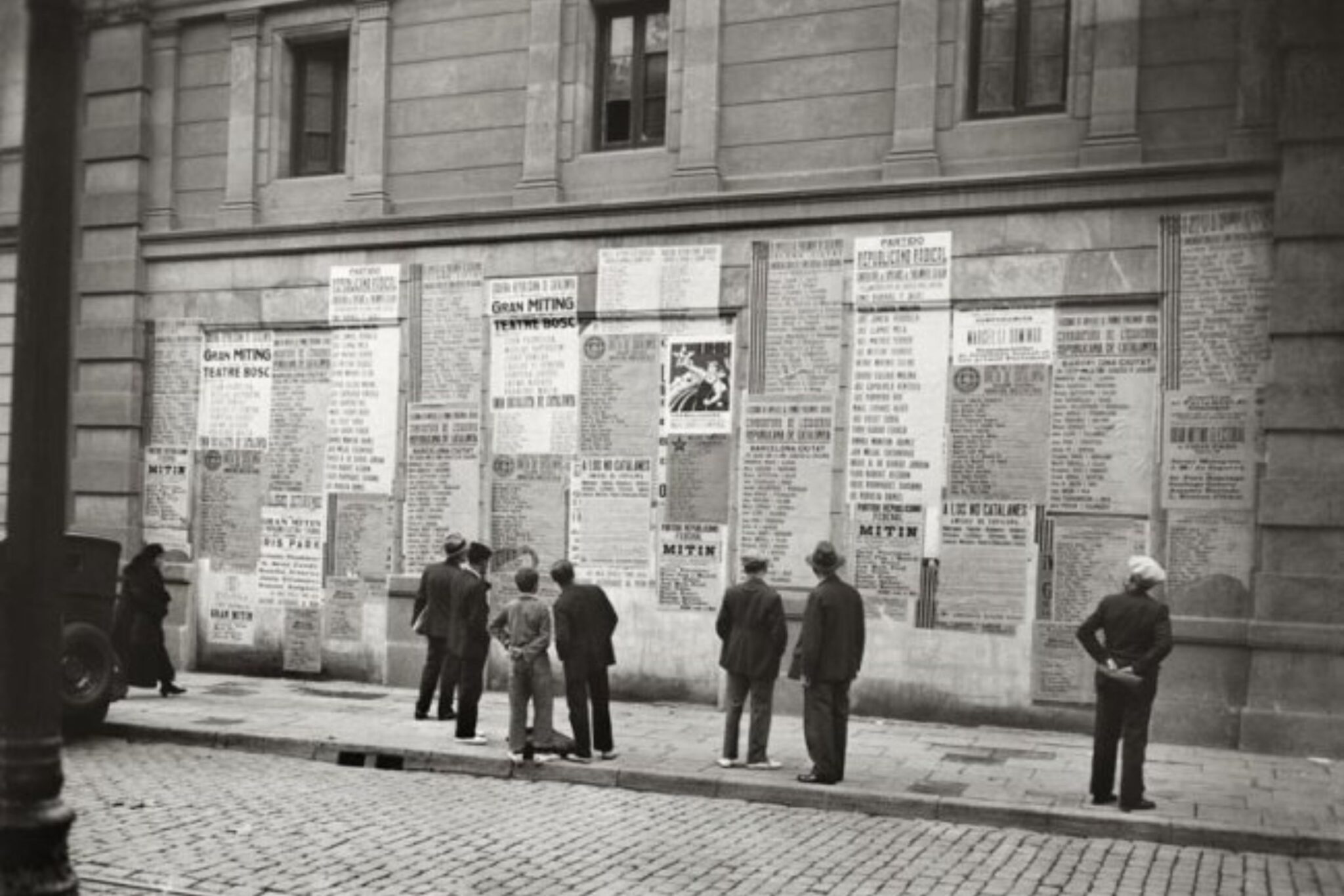
The electoral framework of the Second Republic rested on a substantially modified version of the Maura Law of 8 March 1907 — the legislation inherited from the constitutional monarchy. Its central logic was a partially open, majority-biased system in which voters could cast fewer votes than there were seats to fill, creating structural incentives for large coalitions formed before election day. Two successive republican instruments reshaped it: a provisional decree in 1931 and a full electoral law in 1933.
Provincial constituencies with variable district magnitude. The country was divided into 60–63 multi-member constituencies coinciding broadly with the fifty provinces. Seat allocation followed a ratio of roughly one deputy per 50,000 registered voters, yielding a total of 473 seats across all three elections. The largest cities — those exceeding 100,000 inhabitants in 1931, raised to 150,000 by the 1933 law — formed separate, smaller urban constituencies distinct from their surrounding province. By 1936 these included Madrid, Barcelona, Valencia, Seville, Zaragoza, Bilbao, Málaga, and Murcia.
A winner takes most mechanism. Within each constituency, seats were divided in advance into a majority tranche (roughly 80 per cent) and a minority tranche (roughly 20 per cent). In a province returning ten deputies, for instance, eight seats were reserved for the majority and two for the minority. Each voter could cast a number of votes equal to the majority tranche — eight votes out of ten available seats. Because voters could not fill all seats, the leading coalition was guaranteed the large tranche; the second placed group received the small one, however narrow the gap between them.
Three electoral strategies. Parties and coalitions could choose among three approaches, each with distinct requirements:
- Majority strategy (candidatura de mayorías). A coalition nominated candidates for the majority tranche and competed to win those seats outright. This was the dominant strategy for any coalition with realistic prospects of governing, and required clearing the majority threshold in a single round.
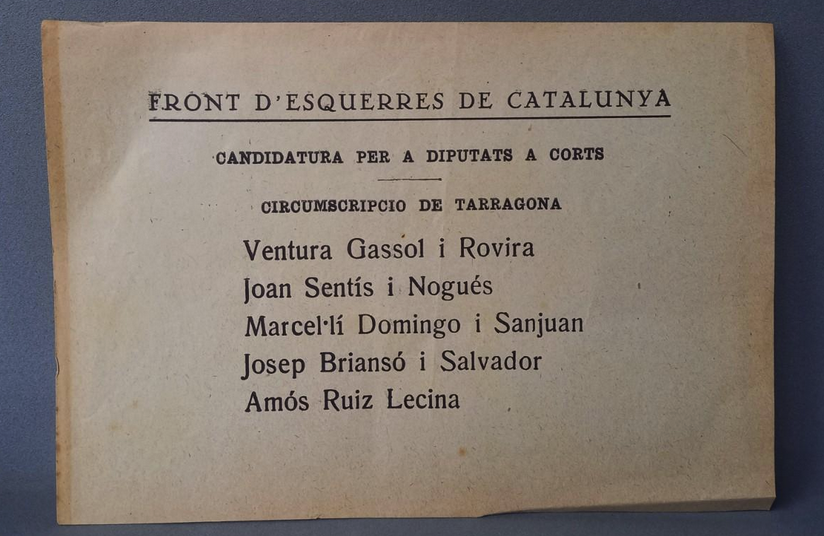
- Minority strategy (candidatura de minorías). A candidacy deliberately targeted only the minority tranche, nominating a reduced slate. Smaller parties, regional movements, or ideologically distinct groups within a broader alliance used this route to guarantee representation they could not have won competing for the majority tranche against a stronger opponent. The threshold required was lower than for the majority.
- Sweep (ir al copo). Since no single candidacy could legally compete for both tranches simultaneously, allied forces deployed two coordinated candidacies — one targeting the majority tranche, one the minority — under a common political umbrella. If both succeeded, the alliance captured all seats in the district, leaving the opposition with nothing. The practice was used in several provinces in 1936 by both the Popular Front (left coalition) and the Nationalist Front (right coalition).
Thresholds and second rounds. To win in a single round, a majority candidacy had to clear the majority threshold; a minority candidacy had to clear its own lower threshold. If no candidacy reached the applicable threshold, a second round was held — in 1931 approximately two weeks later, in 1933 and 1936 at a legislated interval. Second rounds were not marginal: in November 1933, several constituencies required a second ballot on 3 December, meaning national results were not fully settled for nearly two weeks after polling day. In February 1936 five constituencies — Álava, Guipúzcoa, Vizcaya, Castellón, and Soria — required a second round on 4 March 1936.
| 1931 |
20% of votes cast |
20% of votes cast |
Second round ~2 weeks later |
| 1933 and 1936 |
40% of votes cast |
20% of votes cast |
Lists with ≥ 8%; individual candidates with ≥ 20% elected regardless |
Electoral law reforms
From the Maura Law to the republican system
The starting point was the Maura Law of 8 March 1907, named after the Conservative Prime Minister Antonio Maura. Under the Restoration monarchy it relied primarily on single-member rural districts alongside multi-member contests in provincial capitals. It also contained the notorious Article 29, which allowed candidates running uncontested to be proclaimed without a vote — a provision routinely exploited to engineer predetermined outcomes in rural constituencies.
The Decree of 8 May 1931, issued by the Provisional Government, modified the Maura Law for the Constituent Cortes elections. It reorganised the system around provincial multi-member constituencies, abolished Article 29, and transferred authority to validate contested election results from the Supreme Court to a parliamentary credentials committee, reducing judicial oversight of electoral disputes.
It also introduced women's passive suffrage — meaning women could stand as candidates but not yet vote. Clara Campoamor (centrist Radical Republican Party) and Victoria Kent (left republican Radical Socialist Republican Party) were both elected under these rules.
Women's active suffrage — the right to vote — was granted by Article 36 of the 1931 Constitution. In the Constituent Cortes debates, Campoamor championed it; Kent opposed it on tactical grounds, arguing that female voters under strong clerical influence would benefit conservative parties. Women voted for the first time in November 1933.
The Electoral Law of 27 July 1933, passed by the republican Cortes itself, governed both the 1933 and 1936 elections, making modest adjustments to the 1931 Decree. It raised the threshold for a first-round majority victory from 20 per cent to 40 per cent, increased the population threshold for separate urban constituencies from 100,000 to 150,000 inhabitants, and codified the second-round eligibility rules.
Electoral history
From republic to civil war, 1931–1936
The Second Republic held three general elections, one constituent ballot, multiple partial and repeat contests, and the first regional parliamentary elections in modern Spanish history.
12 April 1931
Municipal elections (all Spain). The Republic's founding moment. Republican and Socialist candidates swept Spain's major cities, winning in 41 of the 50 provincial capitals. Though monarchist parties retained an aggregate majority of municipalities, the urban results were interpreted as a plebiscite against the crown. King Alfonso XIII left Spain without abdicating. The Republic was proclaimed on 14 April 1931. A Provisional Government took office under Niceto Alcalá-Zamora (centre right Catholic republican) as Prime Minister and Manuel Azaña (left republican) as Minister of War.
28 June 1931
General election — Constituent Cortes. The Republic's first national ballot, held to elect the assembly charged with drafting the new constitution. The Conjunción Republicana-Socialista, an alliance of left and centre republican parties with the Socialists, won a commanding majority. The Spanish Socialist Workers' Party (PSOE, social democratic) obtained 116 seats; the Radical Republican Party (centrist republicans, led by Alejandro Lerroux) won 94; the Radical Socialist Republican Party (left republican) 56; Azaña's Republican Action (left liberal republican) 26. The fragmented right obtained approximately 30 seats in total. Manuel Azaña became Prime Minister in October 1931, heading a coalition of left and centre republican parties and the Socialists, and pursuing land reform, secularisation of public life, military restructuring, and regional autonomy statutes.
12 Jul / Oct 1931
Second round and supplementary elections, Constituent Cortes. Constituencies where no candidacy had cleared the 20 per cent threshold returned to the polls on 12 July 1931, settling 12 outstanding seats. Irregularities in the Barcelona constituency required supplementary elections on 4 October 1931, with a runoff on 11 October. The final composition of the Constituent Cortes brought total membership to 470 deputies.
20 November 1932
Catalan Parliament elections. The first elections to the Parliament of Catalonia, held after the Statute of Autonomy (Estatut de Núria) was approved by the Spanish Cortes in September 1932. Esquerra Republicana de Catalunya (ERC, centre left Catalan nationalist) won 56 of 85 seats, forming a majority government. Francesc Macià, who had led the provisional Generalitat since April 1931, became its first elected President. He died in office on 25 December 1933 and was succeeded by Lluís Companys (ERC).
23 April 1933
Partial municipal elections (all Spain). Partial elections held in approximately 2,500 municipalities where the April 1931 results had been contested or annulled. The right and centre performed markedly better than two years earlier, signalling a shift in public mood. Combined with a loss of parliamentary confidence, the results led President Alcalá-Zamora to dissolve the Cortes and call a fresh general election.
19 Nov / 3 Dec 1933
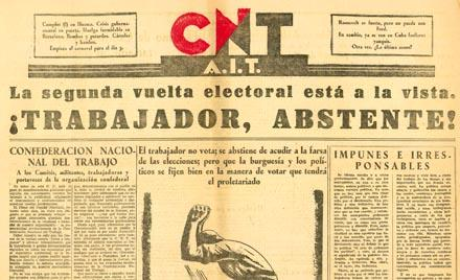
General election — Second Legislature. The first election held under the Electoral Law of 1933 and the first in which women voted. The left ran in disarray: the PSOE (social democratic) stood separately from the republican parties, fragmenting the vote across many provinces. The CEDA (Confederación Española de Derechas Autónomas, Catholic conservative) obtained 115 seats — the largest single party result; the Radical Republican Party (centrist) won 102; the PSOE fell to 59. A second round was held on 3 December 1933 in constituencies where no candidacy had cleared the threshold. Alejandro Lerroux (centrist Radical Republicans) formed a government sustained by CEDA's parliamentary support. The period is known as the bienio negro (two dark years) by the left, or the bienio rectificador (two corrective years) by the right. The entry of three CEDA ministers into the cabinet in October 1934 triggered an armed uprising in Asturias and a separatist declaration in Catalonia, both suppressed, and the Catalan statute was suspended. Recurring crises led Alcalá-Zamora to dissolve the Cortes a second time in January 1936.
14 January 1934
Municipal elections, Catalonia. The only municipal elections held in Catalonia during the Second Republic. Contested across 1,030 municipalities under rules awarding 65 per cent of seats to the winning list, the ballot saw left coalitions prevail overall with approximately 52 per cent of votes. Lliga Catalana (Catalan conservative regionalist) was the strongest single party with around 24.5 per cent; ERC (centre left Catalan nationalist) obtained 18.3 per cent. Left coalitions dominated the Barcelona metropolitan area and the Penedès; the right performed better in Girona, Vic, and Olot. These were the only Catalan municipal elections between 1931 and the transition to democracy in 1979.
16 February 1936
General election — Third Legislature. The most polarised contest of the republican period. The Popular Front (Frente Popular) — a coalition of the PSOE (social democratic), Izquierda Republicana (left liberal republican, led by Azaña), Unión Republicana (centre republican), the PCE (Spanish Communist Party, Marxist), and regional parties including ERC (centre left Catalan nationalist) — won 263 seats on approximately 47 per cent of the vote. The Nationalist Front — grouping the CEDA (Catholic conservative), Renovación Española (monarchist right), the Carlists (traditionalist monarchist), and the Falange Española (fascist, led by José Antonio Primo de Rivera) — obtained 156 seats on a comparable share of the vote. The centre, including the Basque Nationalist Party (PNV, Christian democratic regionalist) and the Radical Republicans (centrist), won 59 seats. Five constituencies required a second round on 4 March 1936.
7 Apr / 10 May 1936
Removal of the President and presidential election. The Popular Front majority invoked Article 81 of the Constitution, which permitted the chamber to censure a President who had dissolved the Cortes twice. On 7 April 1936, 238 deputies voted to remove Alcalá-Zamora (required: 209). Diego Martínez Barrio (Unión Republicana, centre republican) served as interim President. The Constitution required a joint electoral college of sitting deputies and an equal number of compromisarios — specially elected citizen electors, chosen on 26 April 1936 — to elect the new head of state. On 10 May 1936, Manuel Azaña (Izquierda Republicana, left liberal republican) was elected President of the Republic with 754 votes out of 912, well above the required majority of 457. The CEDA (Catholic conservative) and the Carlists (traditionalist monarchist) abstained.
6 May 1936
Repeat elections in Cuenca and Granada. The parliamentary credentials committee annulled the February 1936 results in Cuenca and Granada, citing serious irregularities. Repeat elections were held on 6 May 1936. In Cuenca, a unified Popular Front and centre list obtained 69,407 votes against 48,573 for a coalition of the right and the Falange Española (fascist). In Granada, where the original count had awarded ten seats to the right against three for the Popular Front, the re-run returned a majority of seats to left and left republican parties. Once these results and subsequent seat adjustments were finalised, the Popular Front held 285 seats in the Cortes.
28 June 1936
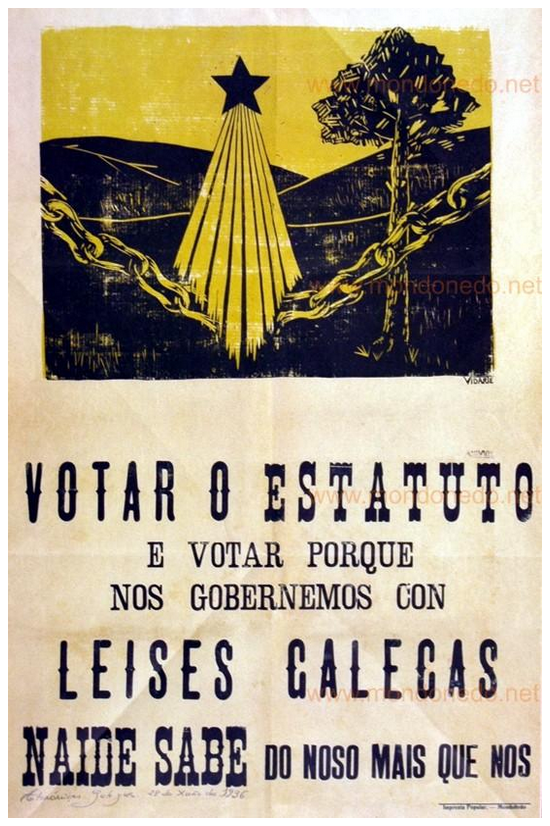
Galician Statute referendum. Galicia held a referendum on its Statute of Autonomy, approved by an overwhelming majority. The military uprising of July 1936 prevented its ratification by the Cortes, and the territory was rapidly seized by the Nationalist forces. The statute was never implemented.
3 October 1936
Basque Parliament elections (wartime). The Spanish Cortes approved the Basque Statute of Autonomy on 1 October 1936. Elections to the Basque Parliament were held two days later in the territory still under Republican control, principally the province of Vizcaya. The PNV (Basque Nationalist Party, Christian democratic regionalist) won 31 of 61 seats. José Antonio Aguirre (PNV) became the first Lehendakari (President of the Basque Country), heading a coalition that included the PSOE, the PCE, and left republican parties.